Encounters Bristol - Tim Lo
News //
Kafka’s Report….reproduced, & other works

16 - 17 September 2016, 8:00pm
Studio D, Simon Fraser University, Goldcorp Centre for the Arts, 149 West Hastings St., Vancouver, BC.
$7 Student/Senior // $10 SFU Staff/Faculty // $15 General
Kafka’s Report…reproduced is based on Franz Kafka’s “A Report to an Academy” (Ein Bericht für eine Akademie), and utilizes the original German text as well as Marc Diamond’s English adaptation. This work is danced en pointe. Kafka’s report is about an ape that is captured by a hunting party somewhere in Africa and brought to Europe. After what appears to be a successful transformation to human-likeness, the ape/human is called to a defense of his accomplishments by a scientific committee. The work is also a subtle reference to George Balanchine’s 1928 ballet Apollo, in which the young Apollo receives instruction from the three muses Terpsichore, Calliope and Polyhymnia before his ascent to Mount Parnassus and the status of God. Daniel’s choreography builds on Kafka’s mischievous commentary on the state of knowledge and the status of the Academy by adding another layer to the story.
Choreography by Henry Daniel
Music by Martin Gotfrit
Original German text spoken by Claudia Hein.
English Adaptation by Marc Diamond
Performances by Marc Arboleda, Chelsea DesLauriers, Megan Morris, Nyssa Song, and Annabelle Wong
Lighting Design and Technical Direction by Kyla Gardiner
The Report (2011) is another version of this work.
Tango la femme is based on a selection of music by Argentinian composer and bandoneon player Astor Piazzolla. It is made for and danced completely by four women.
Muerte del Ángel Dancers: Megan Morrison, Nyssa Song, Annabelle Wong
Music: Astor Piazzolla
Choreography: Marla Eist
Buenos Aires Hora Cero Dancer: Chelsea DesLauriers
Milonga En Re Dancer: Megan Morrison
Oblivion Dancers: Megan Morrison, Nyssa Song, Annabelle Wong, Chelsea DesLauriers
Music: Astor Piazzolla
Choreography: Henry Daniel
Images: Henry Daniel
Costumes: Karen DesLauriers
Lighting Design & Technical Direction: Kyla Gardiner
Presented by the School for the Contemporary Arts at Simon Fraser University
Funded by a SSHRC Small Institutional Grant 2016-2017
Benjamin Meaker Visiting Professorship
Benjamin Meaker Visiting Professorship (Fall 2016)
Read MoreThe Other "D"
...at once an advocacy and a gesture towards strengthening scholarly communities and broadening interaction between dance, drama, theatre, performance studies and beyond.
A two-day symposium. January 22-23, 2016, Centre for Drama, Theatre and Performance Studies, University of Toronto.
"Practices of representation always implicate the positions from which we speak or write – the positions of enunciation. What recent theories of enunciation suggest is that, though we speak, so to say ‘in our own name’, of ourselves and from our own experience, nevertheless who speaks, and the subject who is spoken of, are never identical, never exactly in the same place. Identity is not as transparent or unproblematic as we think. Perhaps instead of thinking of identity as an already accomplished fact, which the new cultural practices represent, we should think, instead, of identity as a ‘production’, which is never complete, always in process, and always constituted within, not outside, representation. This view problematises the very authority and authenticity to which the term, ‘cultural identity’, lays claim".
Hall S. in Rutherford, J (222:1990).
Stuart Hall was a Jamaican-born cultural theorist and sociologist and one of the founders of Cultural Studies and the "New Left Review" in Britain. He left a lasting international legacy on discourses on culture, race, identity and media that is particularly resonant at this moment in time.
John Akomfrah is a Ghanaian-born British writer, director and filmmaker whose body of work speaks to many of the themes that Stuart addressed.
Dr. Daniel McNeil, Professor of History, Migration and Diaspora Studies at Carleton University, will introduce John Akomfrah’s 2013 film The Stuart Hall Project and take part in a Q&A with artists, activists and academics inspired by Hall's commitment to creative, explorative and provocative intellectual work. Professor McNeil will also engage with SFU faculty and graduate students with regards to The Unfinished Conversation, a three-screen installation directed by Akomfrah, and the multiple ways in which Hall has inspired intellectuals inside and outside of academia to do some fresh thinking about time, space and belonging.
FREE EVENTS:
October 14, 12:15-2:00pm Buchanan Penthouse (B501) University of British Columbia, Point Grey Campus Hosted by Dr. Handel Wright and Dr. Alejandra Bronfman Seminar by Dr. Daniel McNeil and discussion with grad students and faculty Lunch served
October 14, 6:00-9:00pm SFU’s Djavad Mowafaghian World Art Studio Goldcorp Centre for the Arts Hosted by Dr. Laura Marks and Dr. Henry Daniel Seminar by Dr. Daniel McNeil and discussion with grad students and faculty
October 15 5:30pm SFU’s Djavad Mowafaghian Cinema Goldcorp Centre for the Arts Public screening of John Akomfrah’s The Stuart Hall Project
7:00-10:00pm SFU’s Djavad Mowafaghian Cinema Goldcorp Centre for the Arts Panel roundtable discussion
Panel Chair: Dr. Handel Wright - Professor and Director, Centre for Culture, Identity & Education, UBC
Respondents: Dr. Daniel McNeil - Professor of History, Migration and Diaspora Studies, Carleton University Dr. Laura Marks - Dena Wosk University Professor, Visual and Cultural Studies, SFU/SCA Dr. David Chariandy - Associate Professor of English, SFU Dr. Adel Iskandar - Assistant Professor of Global Communication, SFU Dr. Alessandra Santos - Assistant Professor of Ibero-American Literatures and Cultures, UBC
Reception to follow
These events are organized by Dr. Henry Daniel, Professor of Dance and Performance Studies at SFU, and Dr. Alejandra Bronfman, Associate Professor of History at UBC, with financial support from the School for the Contemporary Arts at SFU, the Dean’s Office in the Faculty of Communication, Art, and Technology, Institute for Performance Studies, Department of English, School of Communication, Department of History, Institute for the Humanities, School for International Studies, Centre for Imaginative Ethnography, Centre for Policy Studies on Culture & Communication, and the Faculty of Arts at UBC.

Jazz Cosmopolitanism from East to West

Granada Artist-in-Residence
Granada Artists-in-Residence (Spring 2014)
Choreographer and Media Artist Henry Daniel premiered Isabella's Dream from his Project Barca series at the University of California Davis. Learn more about the Granada Artist in Residence program or visit Henry Daniel's faculty profile.

Barca: El Otro Lado
July 23th (Tuesday) & 24th (Wednesday) at 9:30 pm
At Espai 30 - Nau Ivanow- Address: C/ Honduras, 28-30. Metro: la Sagrera, Barcelona.
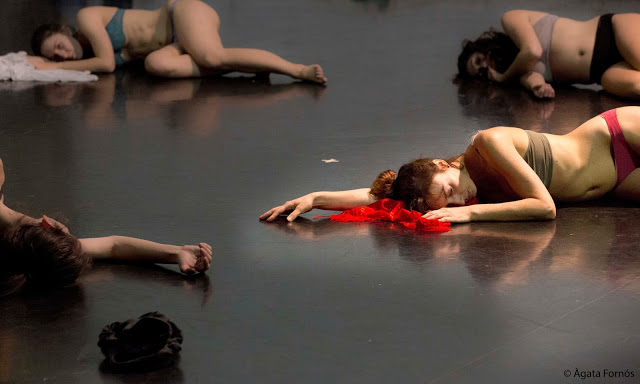
The dancers in this work, who all live in Barcelona, offer their personal narratives to question and provoke issues of identity. Using the historic events of 1492 as a reference point, their performance explores what happens when the human urge to ‘adventure’ takes hold, when the curiosity and excitement of discovery turns to ‘colonization’, and/or occupation of territory; the physical, psychological, and emotional territory of self and other.
Barca: el otro lado is part of an international performance project involving dancers, musicians, and media artists in Canada and Catalonia. The title deliberately uses the city of Barcelona as a vehicle, a barca, for new cross-Atlantic voyages of discovery and understanding, connecting to Vancouver, Canada, at the edge of the Pacific. Going west to find east/going east to find west.
Reservations:
Encounters 2
HBD/NPU
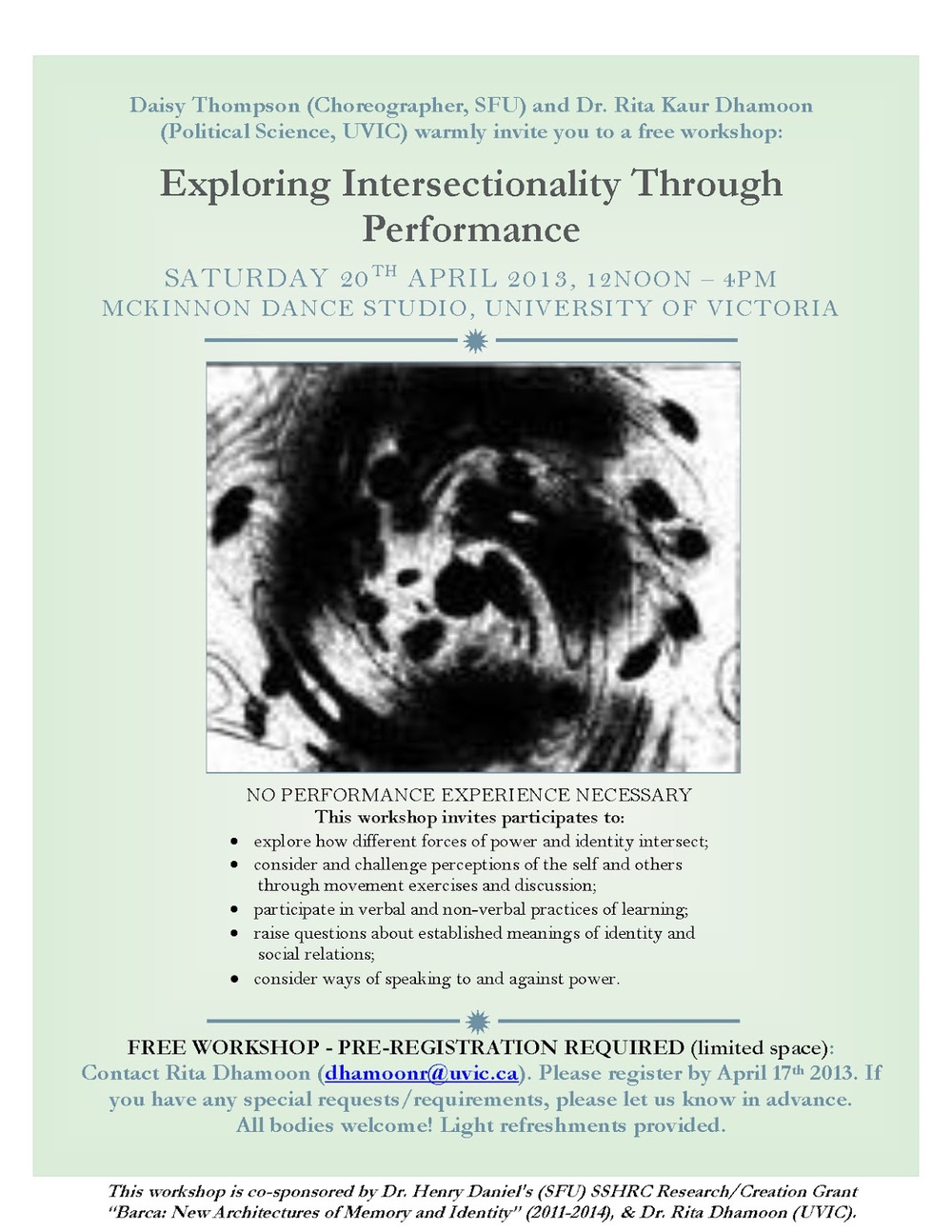
Workshop: Exploring Intersectionality Through Performance, April 20th 2013
Here Be Dragons / Non Plus Ultra Trailer
Process
Daisy Thompson, MFA Researcher - Project Barca.
Coming from a working class background in Britain, I have an interest in the embodied experiences of the working, middle and upper class social identity categories, and how this class system of power operates on the body and consequently, how the body performs this system of power. The readings from Project Barca thus far, drawn from Performance Studies and Intersectionality, have been extremely informative in opening up my ‘thinking’ about my own ‘doing’, regarding the many identities, spaces and practices that I embody: white; female; dancer; performance maker; student; teacher and working class, amongst many more.
Witnessing Henry’s studio based research based on the implications of Christopher Columbus’s 1492 journey, and in particular on his incorporation of the dancer’s personal histories in the work, I am encouraged to excavate the archives of my own body. Furthermore, researching Intersectionality theory ‘‘A framework of analysis…which treats social positions as relational, and makes visible the multiple positioning that constitutes everyday life and the power relations that are central to it” Dhamoon, R (2011), has further encouraged me to consider my position in society, how I am perceived by others and consequently, to examine the intersections of identities that I hold.
Recognizing that I may be perceived as holding a position of privilege being white, I was cautious about my own approach to intersectionality [as to whether I could or should be delving in to intersectionality theory, regarding the analyzing of the intersections of my body and identities of female and working class]. For example, I simply cannot ignore the historic roots and reasons why this framework of analysis was invented in the first place, and that the implementation of such an analysis for my own excavation, could (and maybe already has) be seen as another form of white privilege. However, at present, I have come to the conclusion that it is important for me and others like me - white people, to have a more coherent and differently informed understanding of the experiences of others, who hold multiple identities that are discriminated against. All of this research will be part of my final thesis for my MFA studies.
Throughout this summer, as an interim project, and to expand my interest in alternative modes of education, I will embark on practical and theoretical research, towards the creation of a practical workshop, which will aim to facilitate expanded understandings of Intersectionality through dance and performance. This research will be conducted under the umbrella of Project Barca, and supervised by Dr. Rita Kaur Dharmoon (collaborator on Project Barca). I was inspired and encouraged to pursue this research by Dr. Dharmoon after participating in a task that she led during the first workshop and audition process for project Barca. All participants were gathered in a line facing the same direction, in front of a designated space. She asked a series of identity related questions concerning the social context of Vancouver and to how we felt we were being perceived in this context. We were to answer yes by stepping forward, no by stepping backwards and to remain stationary if if we were unsure.
This exercise was extremely enlightening!
Although I considered myself to be open minded and aware of the discrimination that others were receiving day to day, I realized through this exercise that I hadn’t quite thought about my own position in society – that of being white…and highly privileged! To elaborate on this point, it made me realize just how much I take for granted being in this position in society, and how much I do not take into account the experiences of others with perhaps lesser privileges…it is easy for me to forget that the struggle for equality is still very present amongst many members of society.
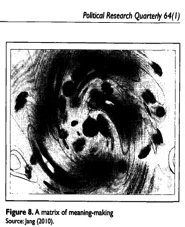
In ‘Considerations on Mainstreaming Intersectionality’ (2011), Dr. Dharmoon refers to Gordon Jang’s matrix of meaning making (2010), she states:
"The idea of a matrix of meaning-making aims to foreground an expanded Foucauldian understanding of power so as to capture the ways in which processes of differentiation and systems of domination interrelate...
While it may be not be possible to develop a diagram of a matrix of meaning-making on paper or in text form because it entails movement among multiple interactions and across time, dimensions, and levels, figure 8, provides some sense of what this might look like"
(pg 238)
.
Inspired by both the visual representation of Jang, and by Dr. Dharmoon’s interpretation of this, I felt that dance could contribute towards the making of a 3-dimensional model, hence
my proposal to create a process-based practical workshop.
The research towards the creation of this educational model will be practice based (movement orientated), but also draw on aspects of performance studies and intersectionality. I believe that by drawing on notions of ‘performance’ such as: stage performance; performance of power and the performance of identity, interesting connections could be made towards a more embodied understanding of ideas/issues within the theory and practice of intersectionality. Vice versa, I also believe that Intersectionality
can be a useful tool for looking at/examining dance and performance...more on this after the initial period of research.
Haikai
Haikai Video Stills
While documenting the Haikai rehearsal process, I found myself fascinated by the gamelon instruments. Below are a few stills from the footage I captured of them, as well as some stills from the Haikai performance.
Oftentimes in a dance piece one is overwhelmed by music, video, and other effects. However, I found that the Haikai composition was very minimalistic. In addition, the calm colors of Remy's 'map media' complimented (and did not overwhelm) the piece. As such, I found the dancers' movements to have more power. The juxtaposition of quiet and sound gave the piece a sort of meditative quality.
It is interesting to go back and edit the footage from Haikai. Being able to see the dancers in close up reiterates the intensity that they brought to the performance. I am currently editing the video footage from Haikai and the Here Be Dragons Preview, as well as logging all footage from the rehearsal process.


Haikai: Identity & Journey
Entry by Marin Beck
“Making art is the process of transforming
raw experience into palatable forms. This transformation is a mimesis, a
representation.”
Thus the following quote from the writing
of Richard Schechner ran through my mind as I watched Haikai on May 20th. After months of delving
deep into theory, both from the field of performance studies and
intersectionality, finally in tangible form there appeared Henry’s ideas of
each dancer’s raw experience and journey translated into performance.
Who are these people? Where did they come from? What is their lived
truth? There is no easy response to such questions; the complexity of relations
is apparent in every movement, every moment when the silence is anything but,
and rather instilled with a flurry of emotion and gesture that speaks volumes
in those apparently empty, soundless spaces.
The choreography effectively captures this multiplicity; intersections
of oppression and privilege appear to occur as one body becomes marked and encounters
systemic challenges. Whether these challenges be racism, colonialism, sexism
etc. – as a viewer we can only guess – but the evidence of such forces is
undeniably there.
The graphics above the stage, of unfocused lines, (like smeared paint) blend, move, and are indiscernible from each other. This came to represent the notion of a “journey” and also how intersectionality may be understood in this piece. When one thinks of a journey, they imagine a place of departure and a place of destination; point A to point B. Simple. It appears linear, but in actuality a journey is incalculably intricate and complicated, full of starts and stops, moments of misdirection, interaction, and encounter. One’s journey is never their own; it bleeds into those they chance upon and those things they cannot predict or avoid (but must endure), irrevocably creating a chain reaction of effect as distinctions become blurred. Each encounter serves as a new point of exposition and counterpoint, in which a new status of being is created, if only for a brief moment. Together the blurred lines of meaning and identity become greater than the individuals apart. These moments of impact with other bodies and systemic forces ultimately decentres any notion of one static understanding – of one’s self, of others, of identity and ultimately – of journey. What is rather apparent is relational experience juxtaposed simultaneously with unique, contradictory difference.
The graphics above the stage, of unfocused lines, (like smeared paint) blend, move, and are indiscernible from each other. This came to represent the notion of a “journey” and also how intersectionality may be understood in this piece. When one thinks of a journey, they imagine a place of departure and a place of destination; point A to point B. Simple. It appears linear, but in actuality a journey is incalculably intricate and complicated, full of starts and stops, moments of misdirection, interaction, and encounter. One’s journey is never their own; it bleeds into those they chance upon and those things they cannot predict or avoid (but must endure), irrevocably creating a chain reaction of effect as distinctions become blurred. Each encounter serves as a new point of exposition and counterpoint, in which a new status of being is created, if only for a brief moment. Together the blurred lines of meaning and identity become greater than the individuals apart. These moments of impact with other bodies and systemic forces ultimately decentres any notion of one static understanding – of one’s self, of others, of identity and ultimately – of journey. What is rather apparent is relational experience juxtaposed simultaneously with unique, contradictory difference.
These moments of impact do not always
appear positive, nor can they be seen as equal.
As one dancer appears, their actions and movements appear to ripple out,
hitting others in waves, hard and soft. Those affected stumble; their body
breaks down into jagged, unsure, and shaky movements as they desperately try to
hold on, perhaps even to fight back. The result is entangled forms and balls of
human misery that appear hardly able to move.
Other bodies are manipulated, moved, pushed, pulled, even carried. Power
is undeniably at play: who does and does not hold power? It invariably shifts,
as some dancers appear in shadow, others in light. No one individual is solely
powerful nor solely powerless, yet undeniably there is an array of situations in
which some have an easier journey, unburdened by unseen privileges. Others appear
much more imbued with struggle and anxiety – the result of debilitating
oppressive forces – roadblocks encumbering their journey from point A to point
B.
The complexity of individual identity and
lived experience is most prominent in the last act of the gamelan piece. The
three “shadow dancers,” marked by their cynicism and hostility, demand
attention from all. They critique that which is occurring around them; they
offer warning and ask why it must be so. They make it stark, how indivisible
power is, in shifting and moving each dancer. Identity is wound up in one’s journey
– inextricably – all the while being formed and altered by those moments of
manipulation, ease, and entanglement. These are moments of acceptance
juxtaposed with instances of stigmatization. The circle is the whole; everyone
is apart of it (by choice or force) yet there are times when they are separate
from it, forced to the outside or the centre. The dancers appear to try to
fight this, the established whole. This idea was most personified by Arash’s
all-consuming violent struggle; was he fighting himself or was he fighting
outside forces as they encroached upon his journey?
Much was going on in the performance from
beginning to end, raising questions of belonging, exclusion, inclusion, and power. It can be understood as a celebration
of the distinctions between each dancer along their journey, but also a
critique of history and present, the dynamics of power that shape us, and the
contradictory and multiple meanings each individual grapples with as they manoeuvre
through the known and unknown.
BARCA sails 'East' ...
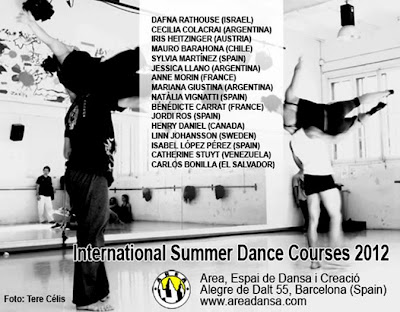
Henry Daniel is giving a 2 week dance intensive (technique and workshop) in Barcelona at A.R.E.A. http://www.areadansa.com/ The workshop will be another occasion to further explore and research material for BARCA. Stay tuned this summer for further developments of the project as it promises to be an inspiring and fruitful summer indeed!
Wondering What We're Doing and Why We Need To Continue
As a third culture kid and a woman of visible minority, I have encountered many interesting situations in my life such as, being called 'Chinatown' in Chinatown, or be told that, 'in Canada, people give others access to the sidewalk', after being bumped into and kicked from behind. Because of these colourful instances, I have learnt to be tolerant and adaptive, but most importantly it has given me a sense of responsibility in addressing racial and cross-cultural issues in my work.
None of my project nor Project Barca will rid our society of racism, or sexism, or agism, or slant glances from one person to the next for whatever reason imaginable. There is a we and a they, a you and a me. I believe that our distinctions make our society interesting and will allow our cultures to continue thriving. By focusing on distinctions rather than differentiations, one examines the world with what is rather than what is not.
Distinctions are circumstantial, rather than generalized as in the case of differencing/othering. Here, we are not only dealing with issues of semantics, but semiotics, which is key in understanding culture. As noted by linguists and anthropologists such as Saussure, Levi-Strauss, and Turner, cultural practices, particularly its fundamental organization of relationships (kinship) and beliefs (myths, and ritual), is tightly intertwined with the formation of symbols in language and speech. Like language and speech, art too is a way to express symbols, and by addressing culturally relevant issues through the lens of art, artists and audience participate in the continual process of construction and deconstruction of culture.
Project Barca recognizes and celebrates the distinctions in each of its members through personal stories, aestheticized performances, and critical analysis. My hope is that this project will be a positive influence on how we think about diversity, that we need not to dilute distinctive cultural traditions, but that we can further these practices in parallel with one another.
---
In another note, I have recently come across a new film called Ghosts with Shit Jobs. It is a mocumentary about Canadians (westerners) in a post economic apocalypse world that takes places in Toronto, Canada. It explores the possibility where most Canadians will have to work jobs that no one in China would take, such as collecting spider silk, making robotic humanoid babies, being a human spam, and a digital janitor. It looks like a highly satirical film and I hope you check it out!
The link below will bring you to the film's trailer.
http://ghostswithshitjobs.com/#&panel1-2
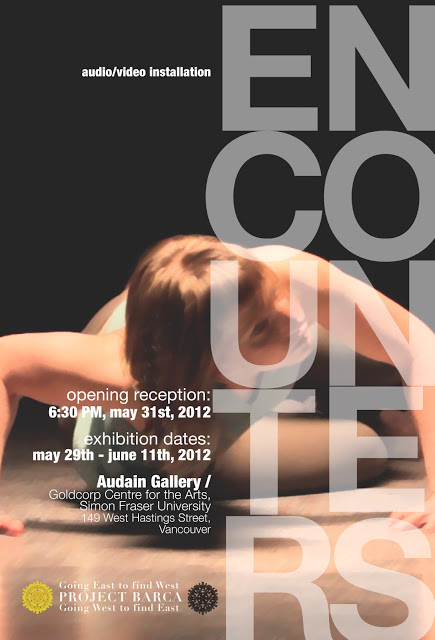
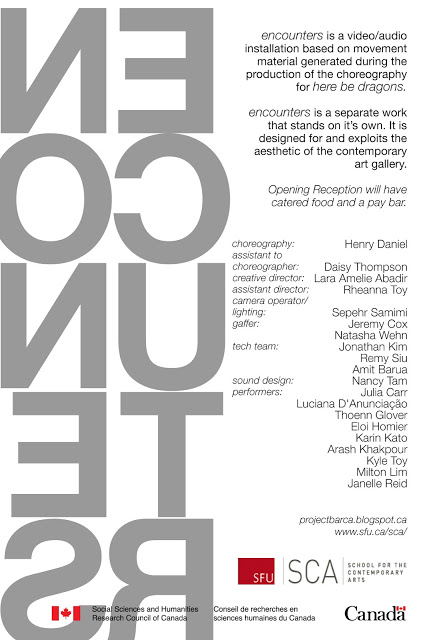
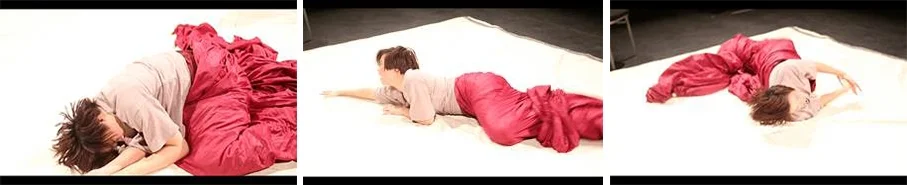
Encounters Teaser
Lara and I are still working on editing for the upcoming Installation encounters. Below is a very short teaser from the choreography of the shadows.
Editing Encounters, Stage 1
7.30 pm. I am sitting in the editing suite with Rheanna, waiting for things to finish rendering- and what better thing to do that make my very first blog entry (ever)?
It's interesting looking over all the footage again and again, each time with new ideas which link all the pieces together. Things are taking shape...some just as planned, other juxtapositions and configurations arise by 'accident' or 'luck'. The outcome will be a variant or a 'projection' of that which what I had imagined and hoped for- something which, I've come to realize, I really enjoy about filmmaking as it keeps me on my toes and shows how creation is a process rather than a product.
And this process is new to me. Sepehr S.(camera/lighting) pointed out, though, that the dancers' choreography (under Henry Daniel) can be compared to a script which then needs to be framed for the screen. This way of looking at it gave me more clarity on what my role entailed, and how to work in such a manner that the ownership of the choreography is respected throughout its adaptation for the projections.
So far, Nancy, Rheanna and I have been working separately: Nancy is creating a surround sound-scape composed of all the recordings she has done throughout the shoot in combination with her own sound (music) compositions. As she was present on set most of the time, she has a clear understanding of what images and structures we have been mapping out along the way. After hearing some of her compositions she brought along to the set as well as her sound installation (part of 'Moulting'...which by the way, blew me away) I can only say that I am waiting like a kid on Xmas eve to see/ hear how things will combine.
Rheanna is currently editing the timeline for the projection of the 'shadows' (Janelle, Milton and Luciana) which will work as a complementary film to the one I am putting together. The first 2 days we were editing in separate suites and meeting up for coffee breaks to talk things over. However, yesterday evening we decided that even though the films work as individual entities on opposing walls, it would only be logic to work on our edits in the same room if we want the installation to make sense as a whole. Also, I haven't been editing this much in last 6 years so have really enjoyed Rheanna's technical skills and input.
It's time for dinner and to give my overworked goggles a rest.
Lara Amelie
It's interesting looking over all the footage again and again, each time with new ideas which link all the pieces together. Things are taking shape...some just as planned, other juxtapositions and configurations arise by 'accident' or 'luck'. The outcome will be a variant or a 'projection' of that which what I had imagined and hoped for- something which, I've come to realize, I really enjoy about filmmaking as it keeps me on my toes and shows how creation is a process rather than a product.
And this process is new to me. Sepehr S.(camera/lighting) pointed out, though, that the dancers' choreography (under Henry Daniel) can be compared to a script which then needs to be framed for the screen. This way of looking at it gave me more clarity on what my role entailed, and how to work in such a manner that the ownership of the choreography is respected throughout its adaptation for the projections.
So far, Nancy, Rheanna and I have been working separately: Nancy is creating a surround sound-scape composed of all the recordings she has done throughout the shoot in combination with her own sound (music) compositions. As she was present on set most of the time, she has a clear understanding of what images and structures we have been mapping out along the way. After hearing some of her compositions she brought along to the set as well as her sound installation (part of 'Moulting'...which by the way, blew me away) I can only say that I am waiting like a kid on Xmas eve to see/ hear how things will combine.
Rheanna is currently editing the timeline for the projection of the 'shadows' (Janelle, Milton and Luciana) which will work as a complementary film to the one I am putting together. The first 2 days we were editing in separate suites and meeting up for coffee breaks to talk things over. However, yesterday evening we decided that even though the films work as individual entities on opposing walls, it would only be logic to work on our edits in the same room if we want the installation to make sense as a whole. Also, I haven't been editing this much in last 6 years so have really enjoyed Rheanna's technical skills and input.
It's time for dinner and to give my overworked goggles a rest.
Lara Amelie
Encounters Opening Reception May 31st, 2012